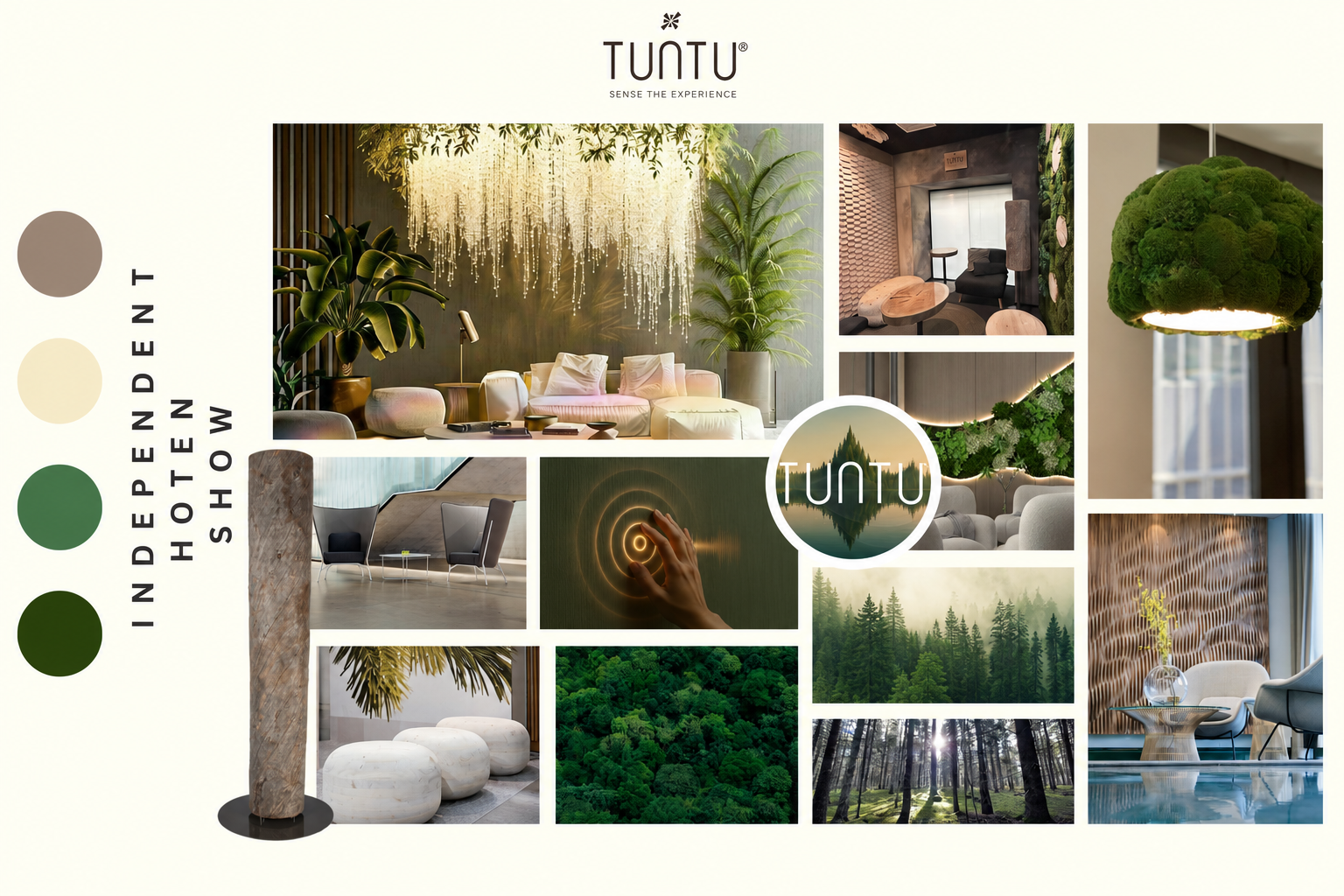

About TUNTU Design – Members Suite Designer
Step into the Members’ Suite at the Independent Hotel Show London, designed by TUNTU. Conceived as a calm retreat from the energy of the show floor, the immersive hospitality space invites visitors to pause, connect, and experience first-hand how sound, spatial design, and atmosphere can influence the way we feel within an environment.
Founded by sound artist and entrepreneur Kirsi Ihalainen, TUNTU operates at the intersection of sound art, neuroscience-informed design, and spatial intelligence. Their work reimagines the relationship between people and the spaces they inhabit - creating environments that go beyond simply housing technology to become responsive, sensory experiences in their own right. Through carefully considered acoustics, materiality, and immersive design, TUNTU crafts spaces that encourage restoration, focus, and meaningful human connection.
Designing with Intention: Q&A with Kirsi Ihalainen
I'm Kirsi Ihalainen, a sound artist, entrepreneur and the founder and CEO of TUNTU. My background sits at the intersection of sound art, spatial design, and neuroscience-informed experience design. I've spent years studying how acoustic environments shape human physiology not just emotion, but nervous system response, cognitive state, and the felt quality of presence in a space.
Before founding TUNTU, I worked extensively with immersive sound and multisensory environments, developing methods for integrating technology invisibly into architecture. That work evolved into a platform that doesn't add technology to spaces it turns the space itself into the medium. Today TUNTU operates as a spatial intelligence company: we design environments that respond to, and actively influence, the people inside them.
Most spatial technology is additive speakers which are placed into a room, lighting rigs are installed, screens are mounted. The room remains passive. TUNTU works from a fundamentally different premise: the environment itself becomes the instrument, spaces become alive.
We embed sound, vibration, light and sensory content directly into architectural surfaces, walls, ceilings, furniture, structural elements with no visible technology. The result is an environment where technology is completely invisible, sound is distributed evenly and felt through the body, and every sensory layer is orchestrated in real time as a single unified experience.
What makes this commercially compelling for high-end hospitality is that it's not about spectacle it's about atmosphere. Guests can't explain exactly why a TUNTU space feels different. They simply feel more present, more at ease, more connected.
1. Physiological design The conversation has moved beyond wellness as a visual language. The most forward-thinking designers and operators are now asking how a space performs biologically: how it affects sleep, stress, focus and recovery. Spatial acoustics, air quality, circadian lighting and sub-sensory stimulation are becoming design criteria, not afterthoughts.
2. Invisible technology The premium marker has inverted. Visible technology even sophisticated technology now reads as mass market. The highest-end spaces are defined by the complete disappearance of infrastructure. When the technology cannot be seen or located, the experience becomes the only reference point.
3. Experience as competitive advantage In a market where product quality has largely converged, experience architecture is becoming the primary differentiator. Guests increasingly choose and return to properties based on how they felt a quality that cannot be replicated by a competitor installing the same furniture or the same bedding. Immersive, multisensory environments are the next non-replicable asset in luxury hospitality.
The finest hospitality creates a place you never want to leave not because there's nowhere better to go, but because the space itself feels so attuned to you that leaving requires a conscious decision. That quality is rare. And it almost never comes from the visual design alone.
I believe it comes from atmosphere, the acoustic character of a room, its light, the way it holds silence, the almost imperceptible sense that the environment is working in your favour. The best hospitality spaces do to people what great natural environments do: they restore something. They return you to yourself.
The most meaningful shift coming in luxury hospitality is that this restorative quality will stop being accidental and start being engineered. TUNTU is designed to be the infrastructure for exactly that.
Designing the Members Suite

"The concept is built around the idea of intelligent stillness the quality that defines the world's most exceptional hospitality spaces. Not emptiness, but a precisely calibrated environment that makes people feel immediately held, present, and away from everything else.
This is the future of luxury: not more materials, more finishes, more visual complexity but more intelligence embedded in the experience itself."
Kirsi Ihalainen, TUNTU Design
The Vision