)

The power of automation to transform independent hotels
Paweł Gawroński, Founder of Staybase (Stand 2305), on the power of automation to reduce guest frustration and free up independent hotel teams.
Guests rarely complain about slow service. They simply don't come back.
When Zonal and CGA by NIQ asked 5,000 UK consumers what frustrates them most about eating and drinking out, the answer wasn't price and it wasn't the menu. It was the wait — 91% named it their single biggest frustration. More worrying for any hotelier: 61% of guests who hit a problem during a visit never return, or return less often. Nobody fills in a comment card. The revenue just quietly leaves.
For independent hotels, that research points at something uncomfortable: most of the money lost in a hotel is lost in the gaps — the terrace order that never got placed, the invoice typed in twice, the wedding enquiry answered on Thursday. Automation, done properly, is simply the business of closing those gaps. Here is what that looks like in practice, with real numbers.
1. Let guests order without waiting
The habit has already flipped: a third of UK guests now prefer to order and pay from the table on their own phone, rising to half of 18–24s. The question is no longer whether guests will scan a QR code — it's whether your operation is ready when they do.
At one Kent country-house hotel, QR ordering went live across the spa, terraces and room service in mid-July. In the first four weeks, guests placed 321 orders worth £8,225 through their own phones — no app to download, orders printing straight at the bar. By week four, almost one pound in three taken in that area came through the phone, and total takings for the area were up on the weeks before launch. The detail worth noticing: the average order through the phone was higher than at the till. A guest who doesn't have to catch a waiter's eye orders the second drink.
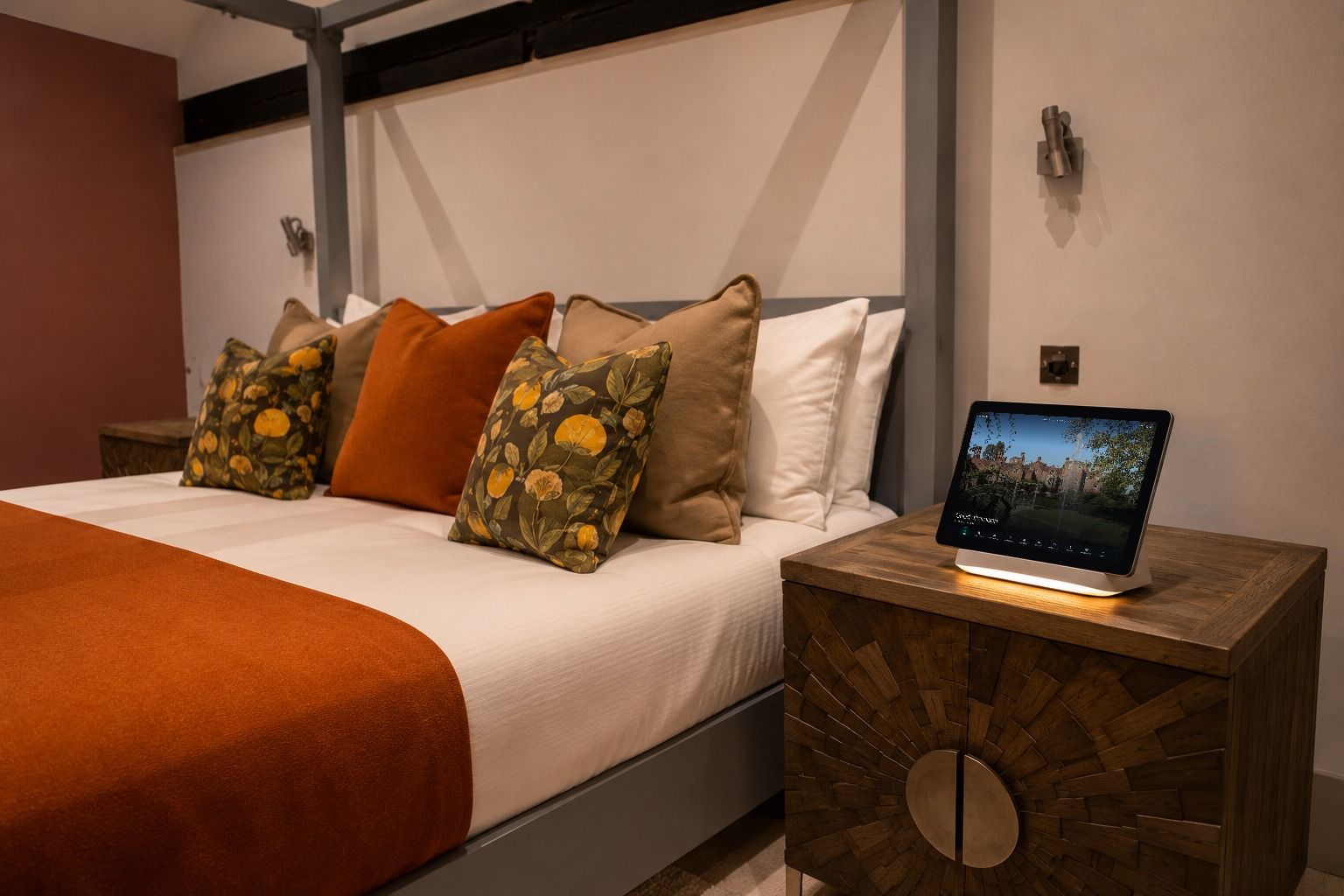
2. Put the hotel on the bedside table
The next step past the QR code is already in rooms: a bedside tablet that greets the guest by name — pulled live from the PMS — and puts the whole hotel one tap away. Orders go straight to the kitchen printer and charge directly to the room folio. The old paper door hanger becomes two buttons: Do not disturb and Make up my room — and the second one doesn't just glow politely, it opens a real ticket in the housekeeping queue and closes it again when the guest changes their mind. A dripping tap gets reported from the pillow and lands in the maintenance queue, categorised, before breakfast.
The details are where automation earns its keep: the alarm clock works even if the Wi-Fi doesn't, and a light sensor turns the screen to near-black the moment the guest switches off the lamp. One UK country-house property switches its rooms on this month — the same platform, the same printers, just without asking the guest to reach for their own phone.
3. One inbox at the front desk — and a phone that isn't a phone
Every one of those guest touchpoints lands in the same place: a single screen at reception. Chats from guests' own phones, requests from the bedside tablets, orders, housekeeping flags — one timeline per stay, with the guest's history and VIP notes beside it, and canned replies for the questions that arrive forty times a day. A message typed there can go to one named guest's tablet — “Mr Smith, your table is booked for 8pm” — or to every tablet in a zone at once when the pool bar closes early.
And when a guest would rather talk than type, the tablet calls reception directly — a real voice call over the hotel's own phone system, no handset in the room required. Out of hours, the tablet says so honestly, and tells the guest when the desk reopens. Nothing rings into the void; everything that arrives is a line in a queue somebody owns.
4. Stop typing supplier invoices
Ardent Partners' 2025 research puts the average all-in cost of processing a single supplier invoice by hand at $10.89, taking 10.9 days from arrival to approval. Best-in-class teams do the same for $2.78 in 3.1 days — because a machine does the typing.
The mechanics are simple: suppliers email a dedicated mailbox; AI reads the supplier, line items, nett, VAT and totals; the invoice is matched against its purchase order, coded, and routed to the right manager — who approves it with one click from their own inbox. For a property handling a few hundred invoices a month, that is a part-time job removed. And because supplier bank-detail switches are how invoice fraud actually happens, a system that flags any change in payment details before a penny moves is quietly one of the strongest security upgrades an independent hotel can make.
5. Answer the event enquiry while it's still warm
Harvard Business Review once audited 2,241 companies with a test sales enquiry. Only 37% replied within an hour. The average response took 42 hours. 23% never replied at all. Yet making contact within the hour makes you seven times more likely to win the lead than waiting even sixty minutes longer.
Couples and corporate planners enquire with several venues in one evening. The venue that replies first — with a proper proposal, not a holding email — usually wins. Automation here means every enquiry landing in one pipeline, a proposal out in minutes, and follow-ups that send themselves when the sales office has gone home.
The part automation doesn't do
None of this replaces people, and it shouldn't try. A tablet doesn't turn down a bed and a workflow doesn't remember that the couple in room 12 got engaged on the terrace last summer. What automation does is give the team its breathing room back — fewer keystrokes, fewer chases, fewer “sorry, I'll just check” — so the hours that used to go into admin go into guests instead. In an independent hotel, where the same person often runs three departments before lunch, that is not a luxury. It is the difference between running the day and being run by it.
The tools for this used to be enterprise-only, priced and built for groups with IT departments. That has changed. The systems described above are all running today in independent UK properties — built, as it happens, inside them.
Paweł Gawroński is the Founder of Staybase — one platform for the operational side of running a hotel, with 25 modules under one login, written over twelve years inside working UK hotels. See it live at Independent Hotel Show London, 5–6 October, stand 2305, or at staybase.co.uk.
Sources
• Zonal & CGA by NIQ, GO Technology report “Fixing people's hospitality bugbears”, May 2024 — survey of 5,000 GB consumers.
• Zonal & CGA by NIQ, GO Technology report “The new age of pub service”, December 2025 — survey of 5,000 GB consumers.
• Ardent Partners, “The State of ePayables 2025”.
• Oldroyd, McElheran & Elkington, “The Short Life of Online Sales Leads”, Harvard Business Review, March 2011 — audit of 2,241 companies.
• QR ordering and tablet figures: platform data from one UK country-house hotel, 16 July – 12 August 2026 (four weeks from launch).
)
)
)
)
)
)
)
)
)
)
)
)
)
)
)
)
)
)
)
)
)
)
)
)
)
)
)
)
)
)
)
)
)
)
)
)
)
)
)
)
)
)
)