)

Meet the design partner: TUNTU
Independent Hotel Show London has partnered with TUNTU to bring the event's Members Suite to life. We caught up with CEO and Sound Artist Kirsi Ihalainen to find out more.
What suppliers and collaborators are you working with to bring the Members Suite to life?
One of the most exciting aspects of the Members Suite is that it is not being created by one company alone. We are bringing together around a dozen Nordic and British companies, each contributing their own specialist expertise, materials or technology to create one unified experience.
TUNTU is leading the overall concept and sensory design, but the space itself is a collaboration across disciplines including sound, lighting, visual content, natural materials, surfaces, planting, technology and hospitality.
What makes this particularly interesting to me is that we are not simply placing different products next to each other. Everything is being designed as part of one environment. Technology, materials, sound, light and physical space all have to work together.
It is almost like an orchestra: each collaborator has their own instrument, but the visitor should experience one composition rather than the individual parts.
What will the physical design of the space look and feel like, and which materials, colours and forms will define it?
The space will feel very different from the exhibition hall surrounding it.
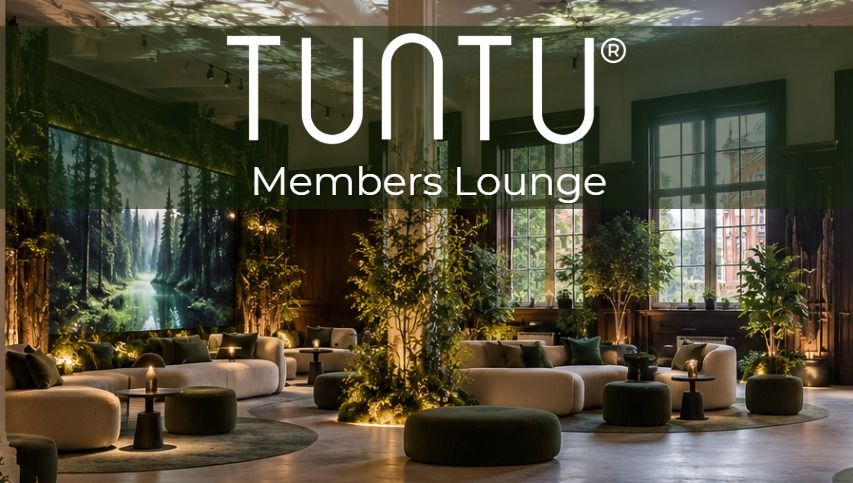
We are working with a palette inspired strongly by Nordic nature: deep greens, earthy and mineral tones, natural wood, stone, moss and planting, combined with carefully controlled light and large scale visual elements.
There is deliberately a contrast between raw, tactile natural materials and almost invisible technology.
Rather than designing a conventional trade show lounge filled with products, we are creating an environment that visitors can enter and experience. Architecture becomes part of the sensory system.
We want people to discover details gradually. Some elements will be immediately visible, while others will only reveal themselves through sound, touch, movement or changes in atmosphere.
The aim is to create something unexpected inside an exhibition environment, a place that makes you instinctively slow down.
How are sound, lighting and technology being integrated into the design?
We don’t want visitors to walk into the Members Lounge and think, “there are the speakers, there are the screens and there are the lights.”
Sound is embedded and integrated into architectural surfaces, allowing walls and other elements of the space itself to become part of the sound system. Low frequencies can also be experienced physically through the body, creating another sensory layer beyond what we normally think of as listening.
Lighting, moving imagery and sound are then designed together rather than as separate systems. The intention is that the atmosphere can change without the visitor necessarily being conscious of why it has changed.
Technology is essential to the experience, but visually we want much of it to disappear.
For me, that is where hospitality technology is heading: away from technology that demands attention and towards technology that quietly changes how a space makes us feel.
The concept is based on “intelligent stillness”. How have you translated that abstract idea into practical interior design decisions?
Intelligent stillness doesn’t mean making a room silent or empty. It means removing unnecessary sensory competition and becoming much more deliberate about what remains.
Every design decision therefore has to answer a question: what does this do to the person experiencing the space?
We are considering where the eye rests, where sound appears to come from, how the body experiences low frequencies, how light moves, which materials people want to touch, and how much information the brain is being asked to process at any given moment.
That has led us towards natural textures, organic forms, concealed technology, distributed rather than directional sound and a visual environment that has depth without becoming visually noisy.
The intelligence is largely invisible. The stillness is what the visitor feels.
How have you approached the challenge of creating an immersive and restorative environment within a busy exhibition hall?
In some ways, the exhibition hall makes the concept even more powerful. Independent Hotel Show is naturally an energetic environment. There are thousands of people, conversations, displays, movement, screens and information competing for attention.
Instead of trying to compete with that intensity, we decided to do the opposite. The Members Suite is designed almost as a transition between two different states. You leave the stimulation of the exhibition and enter an environment where the sensory hierarchy changes. Sound becomes spatial rather than directional, the visual palette becomes calmer, natural materials become more prominent and the atmosphere encourages you to stay rather than move immediately to the next thing.
That contrast is fundamental to the experience. If someone walks in from a busy exhibition hall and, without consciously thinking about it, slows down, stays longer, speaks a little more quietly or simply feels different, then the design has done its job.
What will you do for the Independent Hotel Show London?
We are creating the Members Suite as a collaborative spatial experience that demonstrates what intelligent hospitality environments could feel like in the next decade.
TUNTU is bringing together around a dozen Nordic and British collaborators to create the space, combining expertise in natural materials, interior elements, lighting, visual content, technology and sensory design.
Visitors will enter an environment where sound is embedded and integrated into the architecture itself: no conventional visible speakers or obvious directional audio sources, but an enveloping acoustic presence experienced through the space and, at times, physically through the body. This is layered with choreographed light, large scale visual content, natural materials and a changing sensory atmosphere.
What is important is that none of these elements are intended to exist independently. Together they create one environment.
We want to demonstrate something that is very difficult to communicate through photographs, specifications or brochures. You have to enter it, spend time in it and feel what happens.
And that is really the point of the Members Lounge, so instead of telling people what the future of hospitality could feel like, we want them to experience it.
Can you tell us about the concept?
The concept is built around the idea of intelligent stillness: the quality that defines many of the world’s most exceptional hospitality environments.
It isn’t silence and it isn’t emptiness. It is the feeling that everything around you has been considered so carefully that nothing is demanding unnecessary attention.
We’re creating a space that operates across multiple senses simultaneously: sound distributed through architectural surfaces, low frequency resonance that can be physically felt, moving imagery, carefully choreographed lighting, subttle scent to relax you, tactile natural materials and a layered atmosphere that develops around the visitor.
Ideally, guests won’t consciously analyse those individual elements. They will simply feel that the room is working for them.
For me, that represents an important direction for the future of luxury hospitality. Luxury does not necessarily mean adding more materials, more technology or more visual complexity. It can mean using intelligence to create more feeling with less noise.
What was your inspiration?
The inspiration begins with nature, specifically the way natural environments affect the human body without requiring any conscious instruction.
A forest doesn’t announce what it is doing to you. You enter it, and gradually your breathing changes, your attention shifts and your relationship with the environment changes.
That effortless interaction between human beings and their surroundings has always fascinated me. It led to a larger question of why shouldn’t our built environments be designed with the same understanding of human sensory experience?
Research across fields such as psychoacoustics, environmental psychology and neuroscience increasingly demonstrates how profoundly our surroundings can influence stress, attention, cognition and emotional state.
For TUNTU, the opportunity is to translate that understanding into physical environments.
The Members Suite takes that idea further by bringing together designers, material specialists and technology companies from Nordics and the UK to explore what happens when the environment is treated not simply as something we look at, but as something we experience with the whole body.
That is ultimately what we want people to remember after visiting the space and not necessarily every individual material or piece of technology, but instead how it made them feel.
)
)
)
)
)
)
)
)
)
)
)
)
)
)
)
)
)
)
)
)
)
)
)
)
)
)
)
)
)
)
)
)
)
)
)
)
)
)
)
)
)
)
)