)

Bots and beds: How far should hospitality automate?
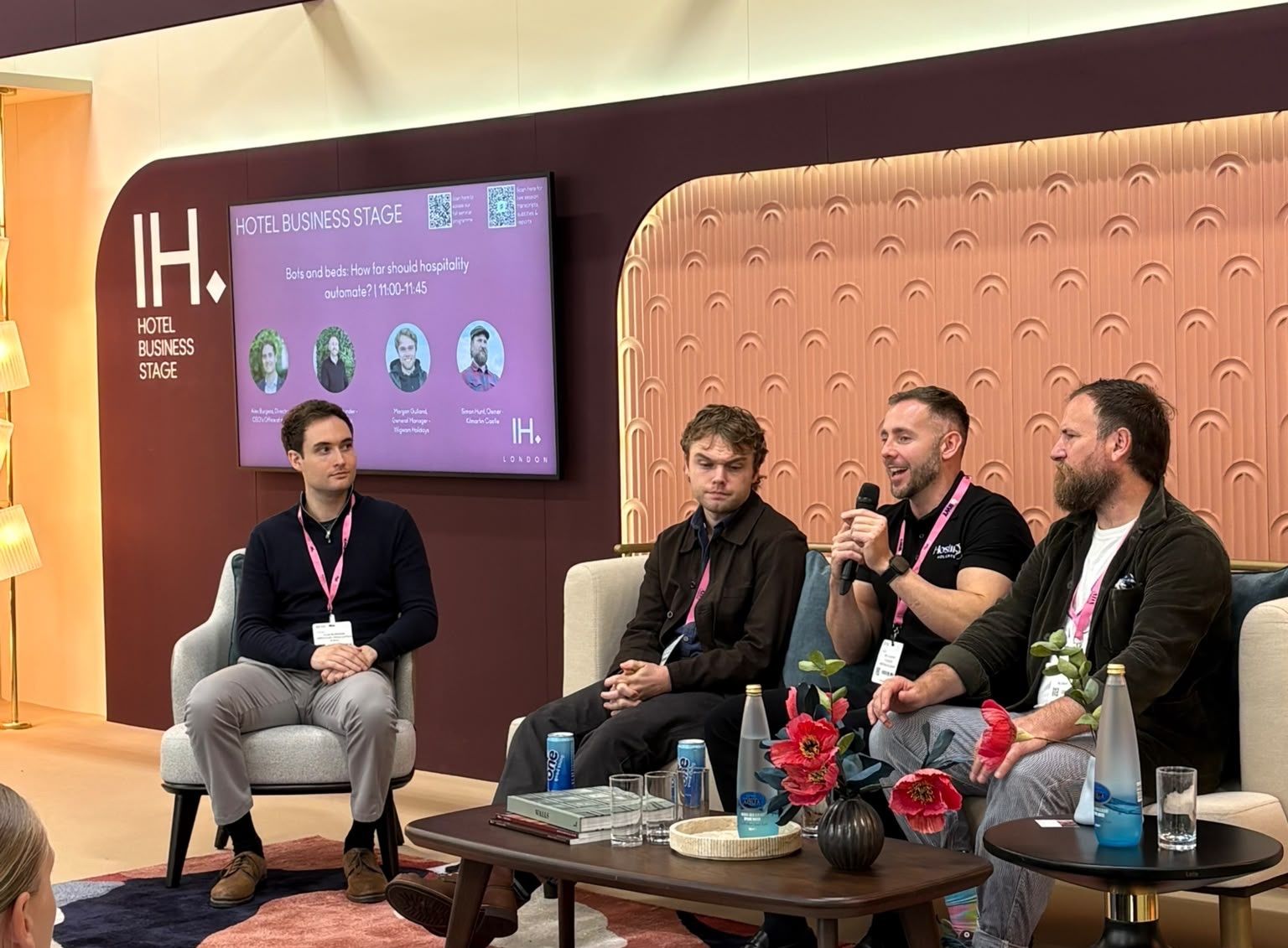
Ben Murphy of Hosting Holidays, Morgan Gulland of Wigwam Holidays and Simon Hunt of Kilmartin Castle joined eviivo’s Alex Burgess to explore how AI and automation can streamline operations and free teams to focus on guests, while preserving the personal touch that defines hospitality.
Artificial intelligence and automation are becoming part of everyday hospitality, but deciding where to use them requires more than a promise of greater efficiency. For independent operators, the question is how technology can support their teams while preserving the personal service that makes a stay memorable.
At the Independent Hotel Show, Alex Burgess, Director – CEO’s Office at eviivo, moderated a Hotel Business Stage discussion with Ben Murphy, Founder of Hosting Holidays; Morgan Gulland, General Manager of Wigwam Holidays; and Simon Hunt, Owner of Kilmartin Castle. The session explored practical applications of AI, the importance of giving systems the right information and where human involvement remains essential.
The Hotel Business Stage is sponsored by eviivo and designed by Merav Bustan Design.
Start with the work that takes time away from guests
One of the clearest opportunities discussed was using automation to reduce repetitive administration. For small teams, time spent processing invoices, gathering figures or preparing reports can limit the attention available for guests.
The panel shared an example of internal invoicing being reduced from a process that previously took around a week to one completed immediately. Consolidating numbers, analysis and metrics into dashboards was another practical application, giving teams access to the information they needed ahead of meetings.
These examples highlighted a useful starting point for operators: identify recurring tasks that absorb staff time, then assess whether automation can make them easier to manage. The value lies in what that recovered time allows people to do, particularly when it creates more space for guest interaction and work requiring human judgement.
Give AI the context it needs
The discussion also explored how connecting AI to business databases can make information more accessible. Allowing staff to ask questions in natural language could help people without development expertise retrieve relevant knowledge from across an operation.
However, the usefulness of these tools depends on the information supplied to them. Businesses need to provide clear operational context rather than expect a system to understand their processes, priorities and requirements automatically.
That principle also applies to development. The session included an example of AI helping accelerate work that might previously have taken months, or potentially as long as 18 months. While the scope of such projects will vary, the discussion illustrated how AI can help operators move more quickly when it has a clearly defined task and sufficient context.
Judge automation by how well it fits the business
A faster process is only valuable if it delivers a worthwhile result for the operation. The panel encouraged businesses to consider whether an automated system fits the way they work, alongside any potential efficiency gains.
Compatibility and setup remain practical considerations, as does the reliability of the output. Early experiments with AI-generated responses had exposed problems, reinforcing the need to test and review content before using it in guest or operational communications.
For independent hotels, this means assessing tools against the needs of the property and its team. A successful application should solve a recognisable problem and produce results that staff can understand, check and use.
Protect human judgement and connection
The session identified safety and the guest-facing human touch as areas where preserving human control is especially important.
Automation can help staff manage routine processes, but hospitality also depends on reading situations, responding sensitively and recognising when a guest needs personal attention. These are considerations operators need to build into decisions about how far to automate.
For smaller businesses in particular, technology can be most useful when it supports the people delivering the experience. Reducing their administrative workload creates more opportunity for the conversations, thoughtful responses and individual touches that guests remember.
Build visibility through detailed content
The discussion also considered how AI is changing the way accommodation is discovered online. AI visibility was described as closely related to existing search engine optimisation, with detailed, useful content continuing to play an important role.
Hotels were encouraged to strengthen their presence across relevant channels, paying attention to both the quality and quantity of their activity. The panel also explored the role of online travel agency profiles in supporting visibility, alongside collaboration with local agencies and users.
For operators, this adds another reason to maintain informative content about their property and guest experience across the channels where potential visitors may encounter them.
The session’s central message was that automation should serve a clear operational purpose. By starting with time-consuming tasks, providing sufficient business context and checking results carefully, independent operators can use AI to support their teams and give them more time to deliver attentive hospitality.
)
)
)
)
)
)
)
)
)
)
)
)
)
)
)
)
)
)
)
)
)
)
)
)
)
)
)
)
)
)
)
)
)
)
)
)
)
)
)
)
)
)
)
)